NAVONE ENGINEERING N-1896 Coherer Detector Marconi Spark Gap Radio Design Receiver
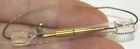
( Brand: Navone Engineering ), ( Manufacturer Part Number: N-1896 ), ( Part Type: Detector Radio Receiver ), ( Country/region Of Manufacture: United States )
Review NAVONE ENGINEERING Coherer Detector Marconi Replica Spark Gap Radio Receiver 1896 Design
The N-1896 Coherer Detector Marconi Spark Gap Radio Receiver, designed in the year 1896 by Navone Engineering, is a captivating piece of historical technology that pays homage to the early days of wireless communication. This exquisite replica is a faithful recreation of the original device developed by Guglielmo Marconi, the Italian inventor who is widely regarded as the father of radio.
The N-1896 Coherer Detector, at its core, is a simple yet innovative device. It consists of a coherer, a spark gap, a battery, and a telegraph key. The coherer, constructed from a powder of silver iodide and charcoal, acts as a sensitive detector that changes its electrical conductivity when it is exposed to an electromagnetic field, such as the radio waves emitted by a distant transmitter.
When a spark is produced in the spark gap, the electrical discharge momentarily aligns the silver iodide particles in the coherer, increasing its conductivity. This altered state is detected by a galvanometer, which in turn signals the reception of a radio wave. The telegraph key is used to send Morse code messages, allowing for two-way communication.
This N-1896 Coherer Detector Marconi Spark Gap Radio Receiver is not just a functional replica; it is a testament to the ingenuity and curiosity that drove the early pioneers of radio technology. It is a perfect addition to any collection of vintage electronics, or for those interested in the history of communication. This device is also a great educational tool for students and enthusiasts to learn about the foundations of radio technology and the scientific principles behind it.
Navone Engineering has meticulously crafted this replica, ensuring that it closely resembles the original design. The N-1896 Coherer Detector Marconi Spark Gap Radio Receiver is made of high-quality materials, with attention to detail in every aspect, from the aesthetics of the device to the functionality of its components. This piece is not only a collector's item but also a fascinating artifact that provides a glimpse into the past and the incredible journey of radio technology.
Pros of buying a (n-1896 Coherer Detector Marconi Spark Gap Radio Receiver 1896 design by Navone Engineering):1. Historical Significance: This device is a replica of the first practical wireless telegraphy system, invented by Guglielmo Marconi in 1896. It allows you to experience and understand the early days of radio communication.
2. Educational Value: Building and using this device can be a great learning experience, particularly for those interested in electronics, history, or radio communication.
3. Unique Collectible: As a replica of a historical device, this radio receiver is a unique and interesting collectible.
4. Functional: Despite its age, the coherer detector and spark gap technology are functional, allowing you to send and receive simple Morse code messages.
Cons of buying a (n-1896 Coherer Detector Marconi Spark Gap Radio Receiver 1896 design by Navone Engineering):1. Limited Range and Quality: The range and audio quality of this device are significantly lower than modern radios due to its outdated technology.
2. Complexity: Building and using this device can be complex and may require a good understanding of electronics.
3. Cost: While not extremely expensive, this device may be more costly than modern radio receivers, especially considering its limited capabilities.
4. Limited Use: Due to its limited range and capabilities, this device is best suited for hobbyists or collectors rather than for everyday use.
Recommendation:The (n-1896 Coherer Detector Marconi Spark Gap Radio Receiver 1896 design by Navone Engineering) is a fascinating and educational device that allows you to experience and learn about the early days of radio communication. However, its limited range, audio quality, and complexity make it more suitable for hobbyists or collectors who appreciate historical technology. If you are looking for a functional radio for everyday use, you may want to consider a more modern option. If you are interested in the history of radio communication and are willing to put in the time and effort to build and use this device, then it could be a worthwhile investment.
Details:
Set the meter to 200 ohm scale, slide power switch on, and gently tap coherer tube with a pencil make sure that it is ready for receiving RF. The ohm reading should be very high, over 20,000 ohms. It can be tapped lightly with a pencil, or automatically mechanical connection to the buzzer bell. The coherer detector was first such practical device and they were held in very high regard for 10 to 15 years.
Marconi sometimes added RF chokes to both ends of the coherer detector feeding pony relay. In the early 1900s, marconi is said to have received three Morse code diets, letters, from across Atlantic ocean with a coherer tube receiver on west, and spark transmitter east. The purpose of RF chokes was to electrically tune receiver so that more than one broadcast could be received at same time in location. Bradley was interested in experimenting, but marconi long range communications.
Of course such a distance can only be achieved if both the transmitter and receiver are connected to earth grounds. Museums use the N-1896 detector as replacement detectors in early receivers.
And the Dem should reset to read a much higher resistance. The voltage that can be applied to a coherer tube circuit is very low somewhere between. This detector was manufactured to tolerances of.
The N-1896 from Navone engineering, inc. He tried gold, platinum, brass, iron, stainless steel, and many more metal filings. De-cohering your coherer: the problem with coherer tube is that once activated, metal filings tend to remain activated in conducting mode until RF removed, and mechanically tapped. History of the coherer detector: in 1892 french physicist Eduardo Bradley first passed RF energy through small quantities metal filings.
The reason for braided electrode wires is that sensitivity of coherer detector adjusted by physically rotating device so as to present more, or less, metal filings gap in between electrodes. The gap between brass electrodes contains a mixture of fine metal filings consisting 93 pure nickel ni and 7 silver Ag. There is no polarity of the coherer to worry about.
Testing your coherer detector: to test marconi Bradley detector, simply connect the red and black alligator clipped leads from a digital volt meter Dem electrode wires detector. And the fourth spark stopped action reset coherer detector for next session. Is a modern replica of marconi - Bradley coherer radio frequency RF detector from 001mm and functions exactly like 19th century tube. Around 1895 Italian experimenter Guillermo marconi refined the Bradley coherer by optimizing electrodes, glass tubing, and metal filings.
5 volts dc and When RF energy is presented to the coherer detector, metal filings instantly and become conductive direct current dc. Bradley was one of the first engineers to place metal filings into a glass tube with closely spaced electrodes for experimenting. It is interesting to note that around 19 a physics professor from India, sir kaddish Chandra Bose, spent years investigating the optimal design for coherer.
Today the bus and robot commonly sell for now tap coheres glass tube with a pencil. The wires connecting brass electrodes through glass coherer tube have same coefficient of expansion as to maintain vacuum. They work great. Rotating the coherer tube along longitudinal axis is of paramount importance in tuning detector.
However, this voltage is sufficient to drive a pony relay when the coherer activated. This detector can be used for demonstrations or as the main a primitive radio receiver. The third spark caused a turn to left. By 1905, the coherer was replaced other forms of detectors that were more sensitive and did not require de-cohere ring process after every Morse code DOT or dag.
The second spark caused wheels to travel in a straight line. Bradley also tested various metals for the coheres gap. This type of tuning was not very effective and well understood at the time. Stronger sparks cause greater RF disturbances leading to longer distances between the TX and Rx sites better radio reception.
The de-cohering process was a detriment to speed that Morse code message could be sent. To this end, marconi designed a primitive radio receiver based on the coherer. The longer aerial wires, greater TX Rx distance.
By the 1920s, vacuum tube could detect, as well amplify, RF signals and coherer detector was relegated to history. The coherer will also work with an analog vim volt ohm meter set to 1000 scale. It is this difference between the low ohm value when activated, and relatively high reading not activated that can be used for radio communications. For collectors.
Repeat the experiment by gently rotating coherer tube. The transmission distance is only a few inches under most conditions. Each electrode face is milled to a matching 15-degree angle and the electrodes are then separated with gap that measures. The battery operated, remote control transmitter used a 2mm spark which was received by bus or robot via TX antenna and complimentary Rx.
The contacts of pony relay can be used to drive a buzzer, bell, an led, or telegraph sounder such as that by marconi. Likewise, one end of the coherer detector can be connected to a ground wire and other an aerial. Mine still works just fine. A water pipe, or earth grounding rod and to elevated, long wire aerials.
The more surface area that is exposed to metal filings, sensitive detector. Construction: the Bradley or marconi coherer is constructed with two 4mm diameter conductive electrodes brass in an evacuated glass tube. Also, the intensity of spark is directly proportional to TX Rx distance.
He experimented, as did marconi, with all sizes and shapes of electrodes glass tubes. Notice that this low ohm reading will remain in place after the spark as gone. The first spark from remote control started bus or robot with a turn to right. The connecting wires are solid inside coherer tube, and braided on outside.
The best material chosen was typically 95 nickel with 5 silver. Notice that there are more and less sensitive positions. A strong spark will drop the meter down to below 20 ohms.
He noticed that the resistance of metal filings changed when exposed to RF energy.
specifications radiparaccessori:
- brand: Navone Engineering
- mpn: N-1896
- part type: Detector Radio Receiver
- country/region of manufacture: United States
Shipping radiparaccessori:
- cost: $0.0
- type: Flat
- handling: days
Returns radiparaccessori:
- paid by: Buyer
- type: Money back or replacement buyers choice
- policy: returns accepted
- time: 30 Days
Seller radiparaccessori:
- city: Stockton, California
- zipcode: 95204
Payments radiparaccessori:
- PayPal
Offer radiparaccessori:
- best offer: true
- Started: September 1, 2018, 10:54 am
- Sold: 0
- quantity: 4
- bids: 0
General radiparaccessori:
- consumer electronics > radio communication > partsaccessories > other parts accessories
- in stock: Yes
- condition: New
Ratings:
- Great service, fast shipping. Thanks! A 08-25-18
- Item as advertised. Prompt delivery 09-01-18
- Smooth deal all the way fast shippimg 08-28-18
- THANKS AGAIN GREAT DEAL A ALL THE WAY 5 STARS GREAT SELLER!!! 08-30-18
- a 08-31-18